Why Are 3-Piece Forged Wheels Ideal for High-Performance Modified Cars?
High-performance modified cars demand components that can withstand extreme conditions while delivering exceptional aesthetics and functionality. Among the most critical upgrades for serious automotive enthusiasts, 3-piece forged wheels represent the pinnacle of wheel technology, offering unmatched strength, customization options, and performance characteristics that standard cast wheels simply cannot match. These sophisticated wheel assemblies have become the gold standard in motorsports and high-end automotive modifications, providing the perfect balance of lightweight construction, structural integrity, and visual appeal that discerning car owners seek.
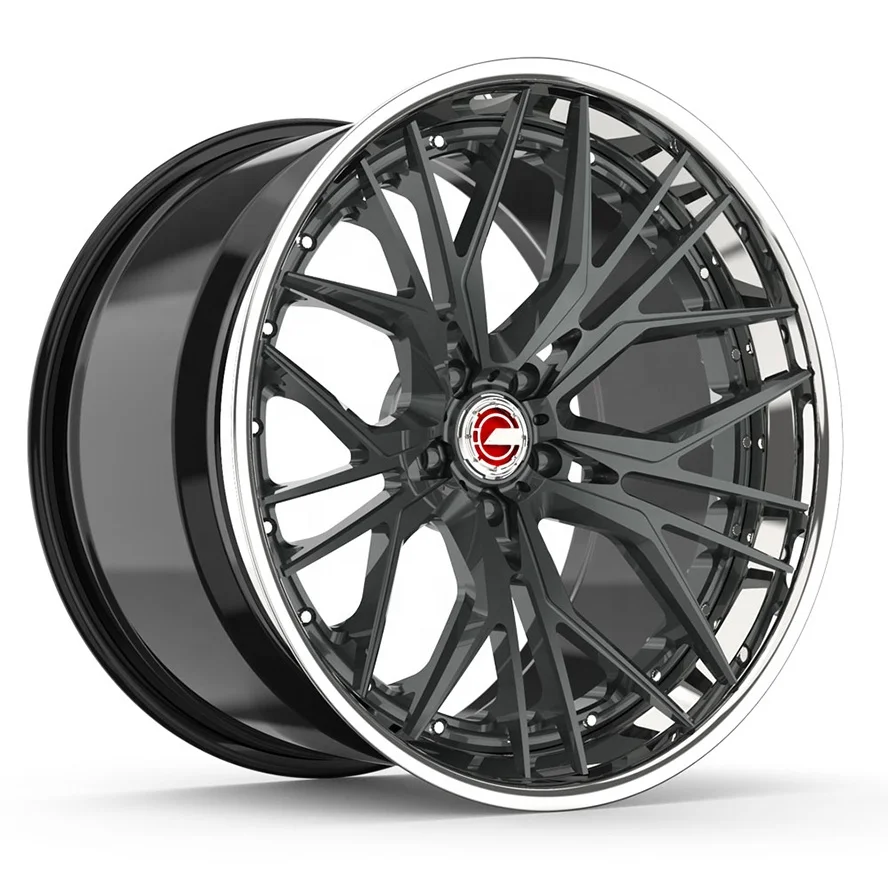
The construction methodology behind 3-piece forged wheels involves an intricate manufacturing process that separates the wheel into three distinct components: the center disk, inner barrel, and outer rim. This modular design approach allows manufacturers to optimize each component independently, using different alloy compositions and forging techniques to maximize performance characteristics. The forging process itself subjects the aluminum alloy to extreme pressure and heat, creating a grain structure that is significantly denser and stronger than cast alternatives, resulting in wheels that can handle the demanding forces encountered in high-performance driving scenarios.
Advanced Manufacturing Process and Engineering Excellence
Forging Technology and Material Science
The manufacturing process of 3-piece forged wheels begins with premium aluminum alloy billets that undergo precision forging under immense pressure, typically ranging from 8,000 to 12,000 tons. This extreme pressure manipulation aligns the metal's grain structure, creating a molecular density that is approximately 20-30% stronger than cast aluminum while maintaining significantly reduced weight characteristics. The forging process eliminates porosity and air pockets that commonly occur in casting methods, resulting in wheels that demonstrate superior fatigue resistance and impact absorption capabilities essential for high-performance applications.
Advanced heat treatment processes follow the initial forging, where the aluminum components undergo controlled heating and cooling cycles to achieve optimal hardness and flexibility characteristics. This thermal manipulation process, known as T6 heat treatment, enhances the material's tensile strength while maintaining the ductility necessary to absorb road impacts without cracking. The precision machining that follows ensures exact dimensional tolerances, with manufacturing specifications typically held to within 0.1mm across all critical surfaces, guaranteeing perfect fitment and balanced rotation characteristics.
Modular Assembly Advantages
The three-piece construction methodology provides unprecedented flexibility in wheel design and maintenance compared to traditional one-piece alternatives. Each component can be manufactured using different alloy compositions optimized for its specific function: the center disk prioritizes strength and bolt pattern accuracy, the inner barrel focuses on structural integrity and brake clearance, while the outer rim emphasizes impact resistance and aesthetic appeal. This specialized approach allows engineers to create wheels that excel in multiple performance categories simultaneously.
Assembly of 3-piece forged wheels involves precision-fitted hardware, including high-grade titanium or stainless steel bolts that secure the components together under specific torque specifications. The modular nature enables replacement of individual damaged components rather than entire wheel replacement, significantly reducing long-term ownership costs. Additionally, the ability to reconfigure barrel depths and rim widths allows for extensive customization options, enabling owners to achieve perfect fitment specifications for their specific vehicle requirements and performance objectives.
Performance Benefits for Modified Vehicles
Weight Reduction and Rotational Mass Optimization
One of the most significant advantages of 3-piece forged wheels lies in their exceptional strength-to-weight ratio, which directly translates to improved vehicle dynamics and performance characteristics. Typical weight savings compared to cast wheels range from 15-25% per wheel, with some premium applications achieving even greater reductions. This unsprung weight reduction has profound effects on suspension behavior, allowing dampers and springs to more effectively control wheel movement and maintain tire contact with the road surface during dynamic driving conditions.
Reduced rotational mass significantly impacts acceleration, braking, and handling characteristics, as the engine requires less energy to accelerate or decelerate the wheel assemblies. This efficiency improvement becomes particularly noticeable in track applications where repeated acceleration and braking cycles occur, with drivers reporting measurably improved lap times and enhanced vehicle responsiveness. The weight reduction also reduces stress on suspension components, potentially extending their service life and maintaining more consistent geometry under load.
Thermal Management and Brake Performance
High-performance driving generates substantial heat through brake systems, and 3-piece forged wheels excel in heat dissipation due to their superior material properties and construction design. The forged aluminum construction provides excellent thermal conductivity, helping to transfer heat away from brake components more effectively than cast alternatives. This improved heat management contributes to more consistent brake performance and reduced brake fade during extended high-performance driving sessions.
The three-piece design allows for optimized spoke configurations and barrel designs that maximize airflow around brake components, creating natural cooling channels that enhance thermal management. Many manufacturers incorporate specific design features such as directional spokes or strategically placed cooling vanes that actively pump air through the wheel assembly during rotation, further improving brake cooling efficiency and maintaining optimal operating temperatures during demanding driving conditions.
Customization Capabilities and Fitment Options
Dimensional Flexibility and Vehicle-Specific Optimization
The modular nature of 3-piece forged wheels enables unprecedented customization possibilities that simply cannot be achieved with traditional one-piece wheel construction. Manufacturers can adjust barrel depths, rim widths, and offset specifications to accommodate virtually any vehicle configuration, from aggressive track setups requiring maximum tire contact patches to street applications demanding specific clearance requirements. This flexibility extends to bolt pattern configurations, center bore dimensions, and load ratings, ensuring perfect compatibility with diverse vehicle platforms.
Custom offset capabilities allow precise suspension geometry optimization, enabling modified vehicle owners to achieve ideal scrub radius, camber curves, and roll center positioning. These geometric considerations become crucial when installing wider tires, lowered suspension systems, or upgraded brake packages that require specific clearance characteristics. The ability to specify exact dimensional requirements ensures that 3-piece forged wheels can accommodate these modifications while maintaining proper vehicle dynamics and safety margins.
Aesthetic Personalization and Finish Options
Beyond functional advantages, 3-piece forged wheels offer extensive aesthetic customization options that allow vehicle owners to create truly unique appearances that reflect their personal style preferences. The separated components enable multi-tone finishing options, with centers, barrels, and lips receiving different treatments such as brushed, polished, anodized, or powder-coated finishes. These combinations create visual depth and sophistication that enhances the overall vehicle appearance while maintaining the aggressive stance that modified car enthusiasts desire.
Advanced finishing techniques available for 3-piece forged wheels include specialized coatings that provide enhanced durability and resistance to environmental factors. Ceramic coatings, PVD treatments, and custom powder coating formulations offer superior protection against corrosion, brake dust accumulation, and road salt damage while maintaining their appearance over extended periods. The ability to refinish individual components also simplifies maintenance and restoration processes, allowing owners to refresh their wheels without complete replacement.
Durability and Long-Term Performance
Structural Integrity Under Extreme Conditions
The forged construction of 3-piece forged wheels provides exceptional durability that surpasses cast alternatives in virtually every measurable category. Impact testing demonstrates that forged wheels can absorb significantly higher energy levels before failure, making them ideal for applications where road irregularities, track curbing, or aggressive driving conditions might compromise lesser wheel constructions. The grain structure created during the forging process provides natural crack propagation resistance, meaning that even if damage occurs, it typically remains localized rather than spreading throughout the wheel structure.
Fatigue resistance testing shows that 3-piece forged wheels can endure millions of load cycles without structural degradation, far exceeding the requirements for street and track use. This exceptional durability translates to longer service life and maintained performance characteristics over time, making them a sound investment for serious automotive enthusiasts. The modular construction also means that individual components can be inspected, serviced, or replaced as needed, ensuring that the wheels maintain their structural integrity throughout their operational life.
Maintenance and Serviceability Advantages
The serviceable nature of 3-piece forged wheels represents a significant advantage over traditional one-piece constructions, particularly for high-mileage or track-driven vehicles. Individual components can be disassembled for thorough cleaning, inspection, and refinishing without affecting the other wheel elements. This capability proves invaluable for maintaining optimal appearance and performance standards, especially in environments where brake dust, road salt, or track debris might otherwise cause permanent damage to sealed wheel constructions.
Regular maintenance protocols for 3-piece forged wheels involve periodic torque checking of assembly hardware and inspection of sealing surfaces to ensure continued proper assembly. The ability to completely disassemble the wheels enables comprehensive cleaning of internal surfaces that accumulate brake dust and debris over time, maintaining both aesthetic appeal and proper balance characteristics. Professional wheel services can also true individual components if minor damage occurs, often restoring perfect roundness and balance without requiring complete wheel replacement.
Applications in High-Performance Motorsports
Track Racing and Competition Requirements
Professional motorsports applications place the most demanding requirements on wheel technology, and 3-piece forged wheels have proven themselves as the preferred choice across numerous racing disciplines. Formula racing, touring car championships, and endurance racing series rely on forged wheel technology to withstand the extreme forces generated during competition, including high-speed impacts, aggressive braking forces, and sustained high-temperature operation. The ability to customize dimensions and specifications for specific racing applications makes them indispensable for competitive motorsports.
Weight regulations in many racing series create additional challenges that 3-piece forged wheels address through their superior strength-to-weight characteristics. Racing teams can achieve minimum weight requirements while maximizing strength and durability, often incorporating exotic materials such as magnesium centers or carbon fiber barrels in specialized applications. The quick serviceability of modular construction also provides strategic advantages during racing events, where rapid wheel changes or component replacement might be necessary between sessions.
Street Performance and Tuning Applications
Modified street vehicles benefit significantly from 3-piece forged wheels technology, particularly those equipped with high-performance suspension systems, upgraded braking packages, and increased power output. The enhanced strength characteristics enable the use of lower-profile tires that provide improved road feel and steering response while maintaining structural integrity under aggressive driving conditions. This capability becomes especially important for vehicles participating in track days, autocross events, or spirited driving sessions where standard wheels might not provide adequate safety margins.
The customization capabilities of 3-piece forged wheels enable perfect integration with modified vehicle aesthetics and performance objectives. Stance enthusiasts can achieve aggressive fitment specifications that complement lowered suspension systems and widebody modifications, while track-focused builds can prioritize function over form with optimized dimensions for maximum tire contact patches and brake clearance. This versatility makes them suitable for the full spectrum of modified vehicle applications, from show cars to dedicated track machines.
Cost Considerations and Investment Value
Initial Investment and Performance Returns
While 3-piece forged wheels represent a significant initial investment compared to cast alternatives, the performance benefits and long-term value proposition justify the premium pricing for serious automotive enthusiasts. The combination of weight reduction, strength enhancement, and customization capabilities provides measurable improvements in vehicle dynamics that directly translate to enhanced driving enjoyment and performance potential. Track-focused applications often see immediate lap time improvements that validate the investment through quantifiable performance gains.
The modular construction methodology provides long-term cost advantages through serviceability and component replacement capabilities that are impossible with one-piece wheel constructions. Individual component damage can be addressed without complete wheel replacement, significantly reducing ownership costs over time. Additionally, the ability to reconfigure dimensions or update finishes extends the useful life of the wheel investment, allowing owners to adapt their wheels to changing vehicle requirements or aesthetic preferences without starting from scratch.
Resale Value and Market Demand
Premium 3-piece forged wheels typically maintain strong resale values due to their construction quality, customization capabilities, and continued demand in the modified car community. Well-maintained sets from reputable manufacturers often retain 60-70% of their original value, making them one of the few automotive modifications that preserve significant investment value over time. The growing appreciation for high-quality automotive components in the collector and enthusiast markets continues to support strong secondary market demand.
Market trends indicate increasing demand for 3-piece forged wheels as more automotive enthusiasts recognize their performance advantages and aesthetic appeal. The expansion of track day participation and modified car culture has created a growing market for premium wheel technology, supporting continued value appreciation for quality examples. This market dynamic makes 3-piece forged wheels not only a performance upgrade but also a sound financial decision for long-term automotive enthusiasts.
FAQ
What makes 3-piece forged wheels stronger than cast alternatives
The forging process compresses aluminum alloy under extreme pressure, creating a denser grain structure that eliminates porosity and significantly increases tensile strength. This manufacturing method produces wheels that are typically 20-30% stronger than cast equivalents while weighing considerably less, providing superior impact resistance and fatigue life that makes them ideal for high-performance applications where structural integrity is paramount.
How much weight can be saved by switching to 3-piece forged wheels
Weight savings typically range from 15-25% per wheel compared to equivalent cast wheels, though some applications achieve even greater reductions. For a complete set of four wheels, this often translates to 20-40 pounds of unsprung weight reduction, which significantly improves acceleration, braking performance, and suspension responsiveness while reducing stress on drivetrain components and improving overall vehicle dynamics.
Are 3-piece forged wheels suitable for daily driving
Yes, 3-piece forged wheels are excellent for daily driving applications, offering superior durability and impact resistance compared to cast wheels. Their strength characteristics make them more resistant to pothole damage and road hazards, while the serviceability allows for individual component replacement if damage does occur. Many owners find them more reliable for daily use than traditional wheels, especially in areas with poor road conditions.
How often should 3-piece forged wheels be serviced or inspected
Regular inspection every 6-12 months is recommended, focusing on hardware torque specifications and sealing surface integrity. Track-used wheels should be inspected more frequently, particularly after intensive driving sessions. Professional disassembly and cleaning every 2-3 years helps maintain optimal performance and appearance, while allowing for thorough inspection of internal components and replacement of sealing materials as needed.
Recommended Products
 Hot News
-
Forged Carbon Products
2024-05-21
-
Forged Off-Road Accessories
2024-05-21
-
GVICHN Introduces Revolutionary Forged Two-Piece Product
2024-05-21
 ONLINE